
Interior Epoxy & Decorative Floors in Sumter, SC
Interior Epoxy & Decorative Floors in Sumter County, SC. Local floor coating specialist with free on-site estimates and written quotes. Call for a quote.
A clean, glossy floor feels good to walk across. A coating that bubbles or lifts after one humid summer feels like money wasted. Sumter Epoxy Floors is a floor coating specialist based in Sumter County, so your estimate, and any follow-up visit, happens close to home. Below you’ll find what indoor epoxy and decorative coatings cost, how preparation decides whether they last, and which of our specialty pages fits your room.
Prefer to talk it through? Tap to call (839) 600-9293.
What Prep Is Included
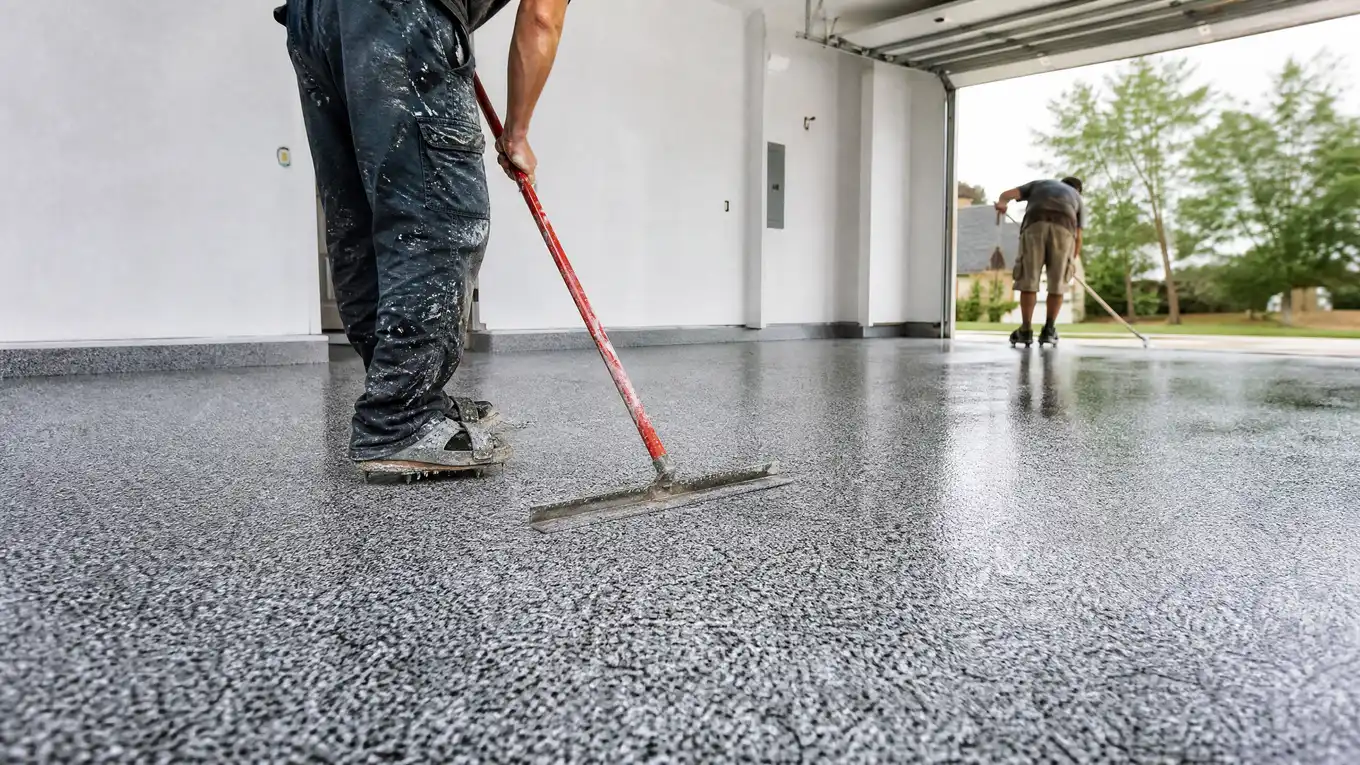
Almost every peeling floor traces back to what happened before the coating went on. Here is the sequence we follow and explain at your estimate:
- Walk the floor and look at it. We check for oil stains, old paint, sealers, cracks, low spots and signs of dampness.
- Test for moisture. More on this below.
- Grind the surface. Diamond grinding removes weak concrete, old coatings and contaminants, and gives the new coating a rough profile to grip.
- Repair. Cracks, pits and spalled edges are filled and leveled.
- Clean and vacuum. Dust left behind keeps a coating from bonding.
- Apply the coating in layers. Primer, color or decorative coat, then a protective topcoat, each given the cure time the manufacturer specifies.
Your written quote lists which of these steps apply to your floor, so you can compare it line by line with any other quote you collect.
How Much Does an Epoxy Floor Cost in Sumter?
Epoxy flooring typically runs $2 to $12 per square foot installed, with materials and labor included (Angi, updated Aug 2026). Where your floor lands in that range depends on the coating type, the condition of the concrete and the size of the space.
A few more benchmarks:
- Water-based epoxy runs about $3 to $7 per square foot, 100% solids epoxy about $5 to $12, and metallic epoxy about $8 to $15 (Intermountain Coatings, July 2025).
- Basic cleaning and etching adds about $1 to $2 per square foot, diamond grinding for damaged concrete about $2 to $4, and crack repair and patching about $3 to $5 (Intermountain Coatings, July 2025).
- Professionally installed epoxy totals about $6 to $15 per square foot, while DIY materials run about $2 to $5 (Intermountain Coatings, July 2025).
- Angi puts a typical one-car garage of about 250 square feet at $750 to $3,000, and a two-car garage of about 500 square feet at $1,500 to $6,000.
A Lexington, SC installer publishes garage floor price bands of $1,500 to $2,500 for base jobs, $2,500 to $4,000 for average jobs and $4,000 to $8,000 for high-end work (Midlands Pro Painters). That gives you a rough local reference point.
These are published ranges, not our prices. The only number that matters is the one on a written quote for your floor, which we provide after a free on-site visit.
Why Humid Summers Matter for Concrete Moisture
Sumter has a humid subtropical climate, with average daily highs of 87.3°F in June, 90.2°F in July and 88.5°F in August (Wikipedia, Sumter, South Carolina). That heat and humidity, combined with moisture rising through a slab, is exactly what can push a coating off the floor.
Polyaspartic coatings should not go on a slab with a high moisture vapor emission rate, because moisture can make the coating bubble and lift (Concrete Network). Epoxy has the same weakness, which is why we look at moisture before choosing a product.
Do I Need to Test My Concrete for Moisture Before Epoxy?
Yes. Moisture testing is the best protection against a coating that fails. Typical epoxy coatings call for slab relative humidity of 75 percent or lower, but the coating maker’s data sheet sets the real limit for each product (One Stop Epoxy).
Two common tests give different information:
- In-situ relative humidity (ASTM F2170). Probes go in at about 40 percent of slab depth for slabs that dry from one side, or 20 percent when they dry from both sides (Wikipedia, Epoxy moisture control system).
- Calcium chloride (ASTM F1869). This measures moisture vapor emission from only the top quarter inch of the slab, so it can miss deeper moisture (Construction Canada).
If a slab reads too wet, the answer is usually a moisture-mitigating primer or a different plan, not skipping the step. We explain the reading and the options in plain language.
Will Epoxy Peel From Hot Tires?
Hot tire pickup is a garage concern, and it is usually a sign of poor prep or a coating mismatched to the job rather than a flaw in epoxy itself. When the concrete is ground properly, tested for moisture and coated with a product made for vehicle traffic, the bond holds up to the heat of a car pulled in after a drive down US 15 or SC 441. We’ll tell you at the estimate if your space calls for something other than standard epoxy.
Epoxy or Polyaspartic: Which Suits a South Carolina Floor?
Epoxy is the usual pick for indoor floors. It builds a thick, hard surface, works with flakes, solid colors and metallic effects, and is generally the more budget-friendly option. Polyaspartic is a faster-curing alternative, often used as a topcoat or in garages exposed to sunlight. Installers describe polyaspartic as UV stable and as lasting 15 to 25 years with care, but those are manufacturer and installer claims, not independent test results (Concrete Network). For a typical two-car garage, a professionally installed polyurea (polyaspartic-type) coating averages around $4,000 (The Home Depot, 2026).
For rooms that never see sunlight, the choice often comes down to finish and budget. We’ll recommend one in your written quote.
Is Epoxy Slippery When Wet?
A smooth, glossy epoxy floor can be slick when wet. Fine grit or a textured topcoat adds traction without making the floor hard to clean. Tell us where water shows up, such as an entry, laundry room, basement or shop, and we’ll build the right texture into the finish.
Can Epoxy Go Over Old Paint or Cracked Concrete?
Usually, but not directly on top. Old paint and sealers have to be ground off so the new coating bonds to the concrete. Cracks and chips are repaired first. Repair cost depends on how much damage there is, which is why we need to see the floor before quoting.
Our Specialist Services
Each interior project has its own look and its own moisture questions, so we keep dedicated pages for the most common ones:
- Metallic Epoxy: Swirling, marble-like color for showrooms, living areas and entryways.
- Basement Floors: Where moisture testing matters most, and where a finished floor makes the biggest difference.
- Kitchen & Interior: Durable, easy-to-clean surfaces for kitchens, laundry rooms and other busy indoor spaces.
Where We Work
We serve homeowners and small business owners in Sumter and nearby communities, including Dalzell, Pinewood, Mayesville, Manning, Bishopville and Camden, along with the Shaw AFB community. The US 15, US 76/378 and SC 441 corridors keep most of these places within easy reach.
What Sets Us Apart
We’re a floor coating specialist based in Sumter County. That means a free on-site estimate, a written quote, and a short drive if you ever need us to take another look. We don’t pressure anyone. If your floor needs more prep than you expected, we show you why. If another approach makes more sense, we say so.
Get a Free Estimate
Tell us about your floor and we’ll come take a look, test where needed and put the plan and price in writing. Call (839) 600-9293 to get a free estimate.
How It Works
From first call to a floor you can drive on
Tell us about the space
Call or send photos of the floor and what you use it for.
We visit and quote
A free on-site visit, then a written quote with every step listed.
Prep the concrete
Grinding, crack repair and cleaning so the coating bonds properly.
Apply and hand over
Coating, finish and a walk-through with care instructions.
Ready for a floor that lasts?
Tell us about your garage, patio or shop floor. We reply with a written estimate and explain exactly how the concrete will be prepared.