
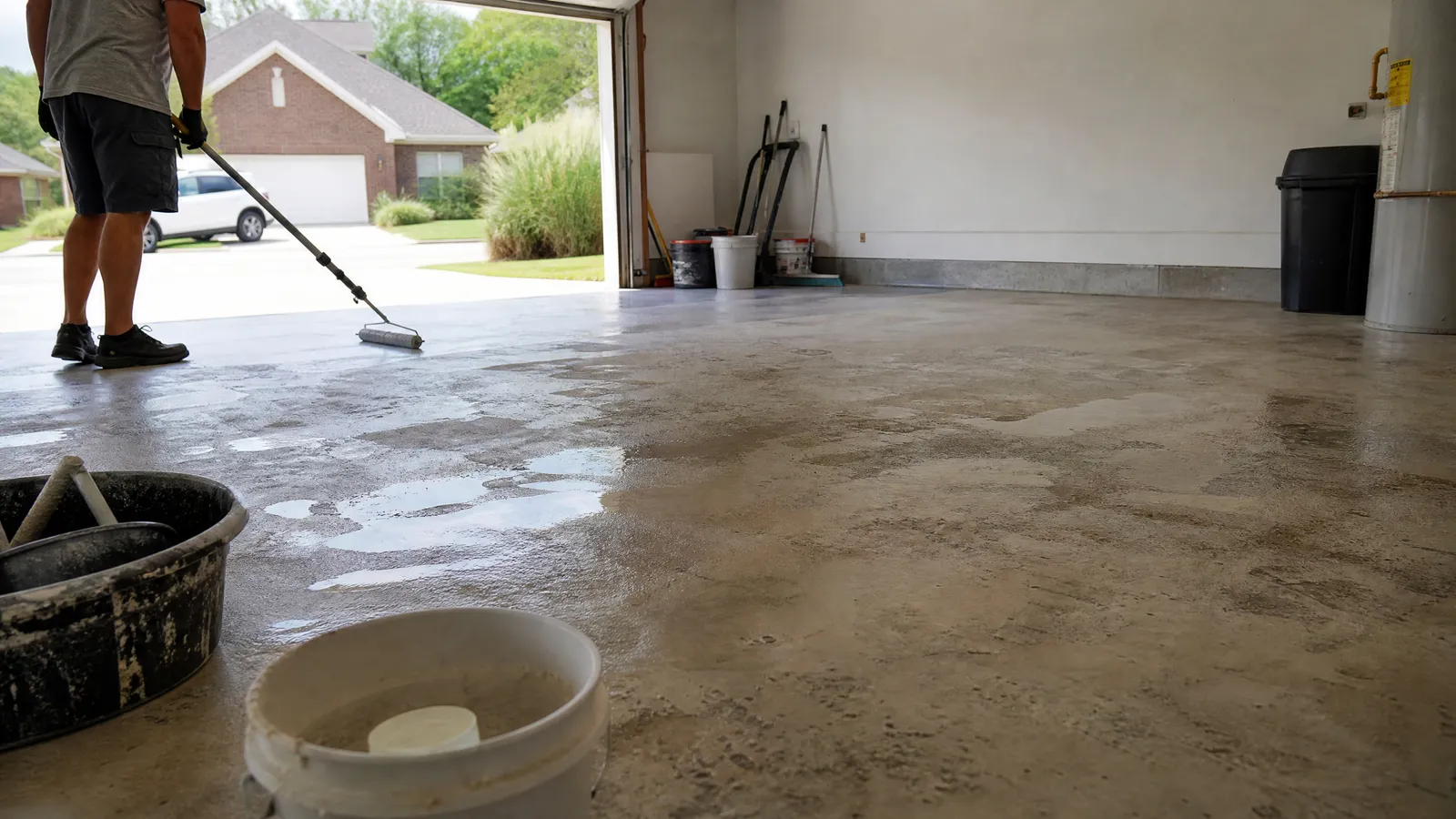
Epoxy Floor Humidity in Sumter, SC: What Summer Does to Concrete
Learn how epoxy floor humidity and Sumter's hot summers affect concrete, how moisture is tested, and what prep protects an Epoxy Garage Floor Coating.
A clean garage floor looks great the day it’s finished. The worry is whether it still looks that way after a Sumter summer. At Sumter Epoxy Floors, the question we’d want answered first is how epoxy floor humidity affects the coating, because moisture in the slab is behind most peeling and bubbling. Sumter’s humid subtropical climate puts real stress on concrete, with average daily highs of 87.3°F in June, 90.2°F in July and 88.5°F in August (Wikipedia, Sumter, South Carolina, accessed Oct 2026). Here’s what that means for your floor.
Why Does Humidity Matter So Much for a Garage Slab?
Humidity matters because concrete is porous and holds water. Moisture in the slab can push up under a coating, and if the coating can’t handle it, you get bubbles, cloudy patches or peeling. The problem usually starts below the surface, so a floor can look dry and still be wet inside.
Many garage slabs sit on soil with no reliable moisture barrier under them. Ground moisture moves up through the concrete as vapor, and warm, damp air in the garage adds to the load. Epoxy forms a tight film on top, so vapor that can’t escape pushes against it. Coatings are not all equally tolerant. Polyaspartic coatings, for example, should not go on a slab with a high moisture vapor emission rate, because moisture can make the coating bubble up and lift (Concrete Network, What’s the Best Concrete Garage Floor Coating?, accessed Oct 2026).
How Is Concrete Moisture Actually Tested?
Moisture is tested with simple measurements taken from the slab itself, and the result tells us whether it’s safe to coat. Two methods come up most often, and they measure different things.
- In-situ relative humidity (ASTM F2170): Probes go into holes drilled in the slab, at about 40 percent of slab depth when it dries from one side, or 20 percent when it dries from both sides (Wikipedia, Epoxy moisture control system, accessed Oct 2026). This reads moisture deeper in the concrete.
- Calcium chloride test (ASTM F1869): This measures vapor emission from only the top quarter inch of the slab, so it can miss deeper moisture (Construction Canada, Concrete flooring: Mitigating vapour-related failures, accessed Oct 2026).
Typical epoxy coatings call for slab relative humidity of 75 percent or lower, but the coating maker’s data sheet sets the real limit for each product (One Stop Epoxy, Moisture testing before installing epoxy flooring, accessed Oct 2026). That’s why we check the product’s own requirements rather than relying on a general rule.
What Does Good Prep Look Like in a Damp Climate?
Good prep means the slab is clean, open and dry enough to accept the coating. Here’s the sequence, step by step:
- Inspect and test. We look for old sealers, oil stains, cracks and signs of past moisture, then test the slab where it matters.
- Grind the surface. Diamond grinding removes weak concrete and old coatings, and it opens the pores so the coating can grip. Basic cleaning and etching adds about $1 to $2 per sq ft, and grinding for damaged concrete adds about $2 to $4 per sq ft (Intermountain Coatings, Epoxy Flooring Cost Per Square Foot guide, July 2025).
- Repair defects. Cracks and chipped joints get filled and leveled. Crack repair and patching adds about $3 to $5 per sq ft (Intermountain Coatings, July 2025).
- Choose the system. If moisture readings are high, we talk through a moisture-control primer or waiting before coating, rather than covering the problem.
- Coat in the right conditions. Humid mornings and hot afternoons both affect cure, so timing matters.
You can read how this fits into the full job on our Epoxy Garage Floor Coating page.
Does Summer Weather Change How Epoxy Is Installed?
Yes. Heat speeds up how fast the coating sets, and humid air can affect how it cures. In a Sumter summer we plan the work around cooler parts of the day and keep the garage ventilated, so the coating has time to level out and bond.
A few things you can do as the homeowner: run a fan or dehumidifier in the garage in the days before the visit, clear the floor completely, and fix any gutter or downspout that sends water toward the slab. A wet spot along one wall is worth pointing out at the estimate. If you’re curious about cost, one-car garages of about 250 sq ft typically run $750 to $3,000, and two-car garages of about 500 sq ft run $1,500 to $6,000 (Angi, How Much Does Epoxy Flooring Cost?, updated Aug 3, 2026). Prep needs on a damp slab are one reason the written quote can sit anywhere in that range.
Key Takeaways
- Moisture rising through the slab, not surface dirt, is behind most bubbling and peeling in humid climates.
- Deeper tests like in-situ relative humidity give a fuller picture than surface-only tests.
- The coating maker’s data sheet sets the moisture limit for each product.
- Grinding, repairs and moisture checks are what make a coating last, so ask to see them in any written quote.
- Fixing drainage near the garage helps any floor coating.
Get a Free Estimate
If you’re in Sumter or a nearby town and want your slab checked before you commit, we’ll come out, talk through prep and moisture testing, and give you a written quote. Call (839) 600-9293 or request a Get a Free Estimate through our Epoxy Garage Floor Coating page.
Frequently Asked Questions
Yes, as long as the slab is dry enough and the air is controlled during the job. Summer heat and humidity change cure times, so the installer should plan around temperature and check moisture readings first. The product's data sheet gives the working limits.
Visible signs include dark patches, white powdery residue or a musty smell, but the only reliable answer is a moisture test. A quick plastic-sheet check can hint at a problem, while a relative humidity test gives a clearer reading before any coating goes down.
It can if the slab was never tested or the product wasn't suited to it. Rising vapor can cause bubbles or lifting under the film. Testing first and choosing a coating rated for the slab's moisture level greatly reduces that risk.
Ready for a floor that lasts?
Tell us about your garage, patio or shop floor. We reply with a written estimate and explain exactly how the concrete will be prepared.