
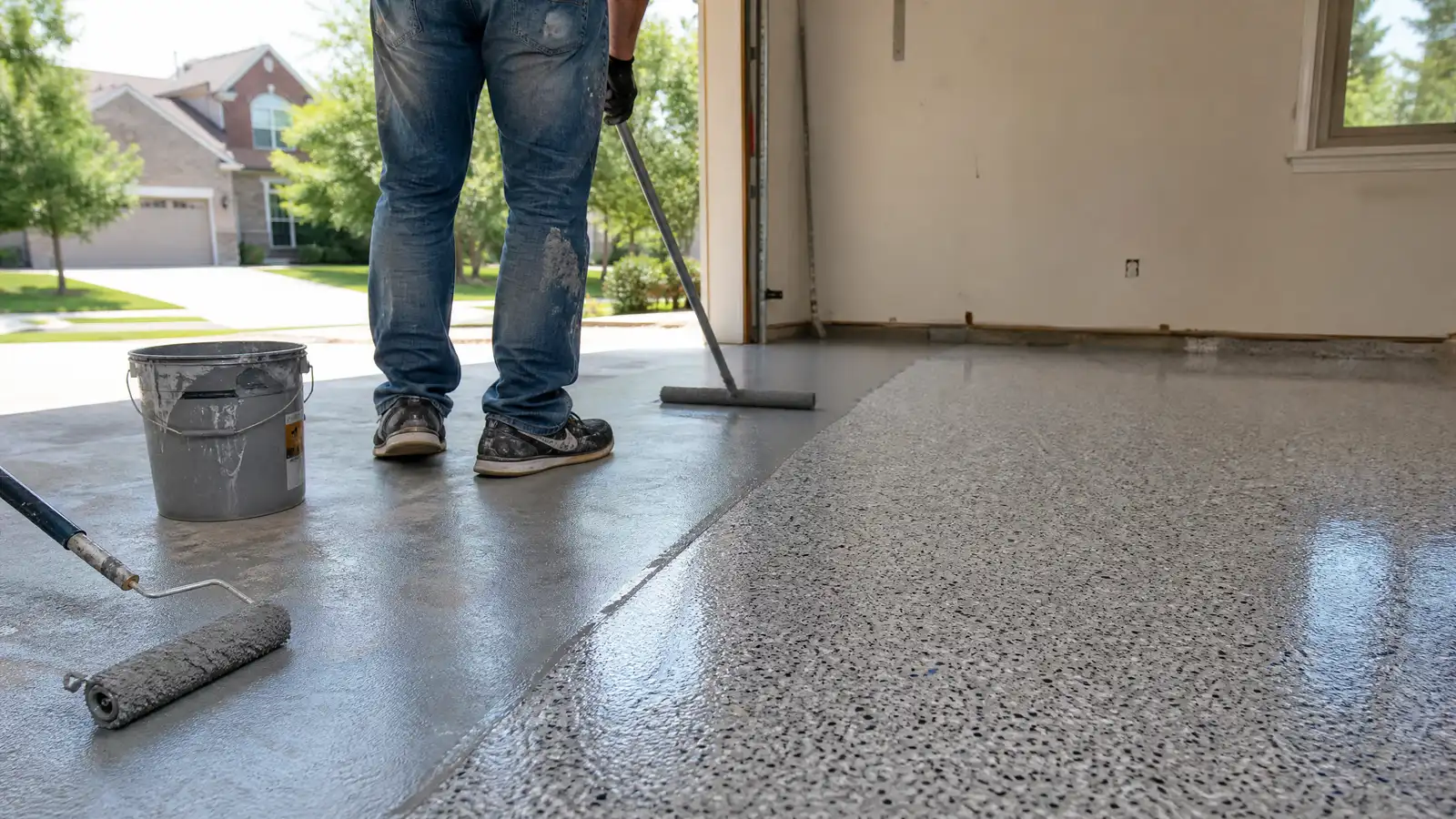
Epoxy Floor vs Floor Paint in Sumter, SC: What Is the Difference?
Epoxy floor vs paint: learn how they differ, why prep and moisture testing matter, and what each costs. A helpful guide from our Epoxy Garage Floor Coating team.
Nobody wants to spend a weekend rolling a fresh coat on the garage floor, only to see it lift under the tires a few months later. At Sumter Epoxy Floors, we get why the epoxy floor vs paint question matters: the products look alike in the can, but they behave very differently on concrete. This guide explains what each one is, where each makes sense, and why the work done before the coat goes down matters more than the label on the bucket.
What Is Actually in the Can?
Garage floor paint is usually a thin, single-component coating, often acrylic or latex. It dries as the water or solvent evaporates and leaves a light film on top of the concrete. It is easy to roll on and cheap to buy, but the film is thin and bonds mostly to the surface.
A true epoxy coating is a two-part system. A resin and a hardener are mixed right before application, and they cure through a chemical reaction instead of simply drying. That reaction produces a thicker, harder layer that grips the concrete far better.
The confusion comes from “epoxy paint” or “epoxy-acrylic” products sold at home centers. Many are mostly paint with a small amount of epoxy added. If you are comparing epoxy paint vs epoxy coating, check the label for a separate hardener and ask how much solid material is left on the floor after curing. A two-part, higher-solids product is the real coating.
Why Prep Decides How Long Either One Lasts
Most peeling comes from what happened before the coating, not the coating itself. Concrete is porous, and it holds oil, dust, and old sealer that block a good bond.
Here is how prep usually goes for a floor coating that is meant to last:
- Clean and degrease. Oil stains left in the slab can push a coating off from below.
- Grind the surface. Diamond grinding opens the pores and removes weak surface material. Etching with acid is the lighter option for sound concrete.
- Repair cracks and pits. Fill and level them so they do not telegraph through the finish.
- Test for moisture. More on this below.
- Apply in the right conditions, following the maker’s data sheet for temperature and cure times.
Prep is also a real part of the price. Intermountain Coatings (July 2025) puts basic cleaning and etching at about $1 to $2 per square foot, and diamond grinding for damaged concrete at about $2 to $4 per square foot. Paint kits usually skip the heavy grinding, which is one reason they cost less and tend to wear sooner.
Humid Summers and Moisture in the Slab
Sumter has a humid subtropical climate, and average daily highs reach 87.3°F in June, 90.2°F in July, and 88.5°F in August (Wikipedia, Sumter, South Carolina). Concrete slabs sit on the ground and can pass moisture vapor upward. Trapped under a coating, that vapor can cause bubbles and lifting.
Typical epoxy coatings call for slab relative humidity of 75 percent or lower, though the coating maker’s data sheet sets the real limit for each product (One Stop Epoxy, moisture testing guide). The ASTM F2170 in-situ test places probes at about 40 percent of slab depth for slabs that dry from one side (Wikipedia, Epoxy moisture control system). The ASTM F1869 calcium chloride test only measures the top quarter inch, so it can miss deeper moisture (Construction Canada).
Paint is not immune. A damp slab can lift it just as easily, so testing is worth doing whichever product you choose.
Hot Tires, Wear, and Cost
Hot tire pickup happens when warm rubber softens a weak coating and pulls it off the floor. Thin paint is more prone to it. A properly prepped, fully cured two-part coating resists it better, which is why many Sumter and Shaw AFB-area garages that see daily driving go with a real coating over paint.
On cost, Angi (updated Aug 3, 2026) lists epoxy at $2 to $12 per square foot installed, and $750 to $3,000 for a one-car garage of about 250 square feet. ArmorGarage (2026) puts DIY kits at $1.08 to $2.66 per square foot, against $7 to $9 for professional installation. The difference is mostly prep, product thickness, and labor.
Paint can suit a lightly used storage space or a floor you plan to redo soon. For a garage that takes vehicles, tools, and spills, our Epoxy Garage Floor Coating page covers how we approach it.
Key Takeaways
- Floor paint dries into a thin film; true epoxy is a two-part coating that cures chemically and builds a thicker layer.
- “Epoxy paint” on a store shelf is often mostly paint, so check for a separate hardener.
- Grinding, repairs, and moisture testing do more to prevent peeling than the product name.
- Humid South Carolina summers make slab moisture a real concern for any coating.
- DIY paint costs less up front, but a prepped professional coating is built for daily vehicle use.
Get a Free Estimate
If you are weighing paint against a real coating for your garage, patio, or shop floor, we offer a free on-site estimate and a written quote, with the prep steps explained. Serving Sumter, Shaw AFB-area neighborhoods, and nearby towns, we are close by for a visit or a fix. Call (839) 600-9293 or visit our Epoxy Garage Floor Coating page to Get a Free Estimate.
Frequently Asked Questions
For most garages that park vehicles, yes. A two-part epoxy coating is thicker and bonds deeper into prepped concrete, so it resists hot tires, oil, and wear better. Paint can work for light-use areas, but it usually needs recoating sooner.
Not safely without prep. Old paint can be a weak layer that peels and takes the new coating with it. It normally needs to be ground off so epoxy bonds to bare concrete. An on-site look at the floor tells you how much is needed.
No. Epoxy paint is typically a one-part or blended product that dries like paint. An epoxy coating is mixed from resin and hardener and cures chemically, leaving a tougher, thicker film. Read the label and the data sheet before you buy.
Ready for a floor that lasts?
Tell us about your garage, patio or shop floor. We reply with a written estimate and explain exactly how the concrete will be prepared.