
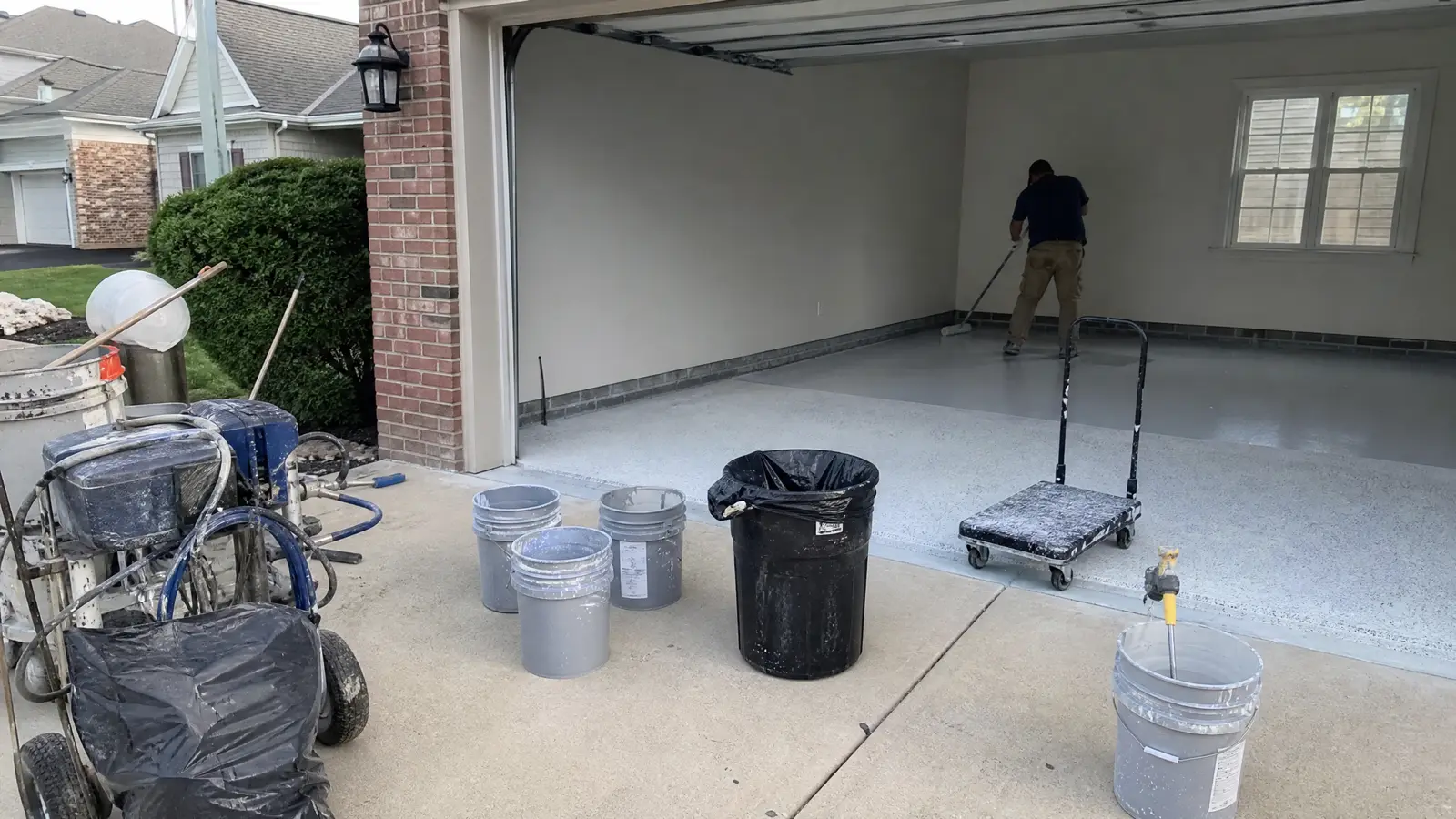
Epoxy Garage Floor Coating in Sumter, SC
Epoxy Garage Floor Coating in Sumter County, SC: a tougher, easier-to-clean floor that resists oil, prepped properly and priced in writing. Call for a quote.
Call (839) 600-9293 to talk through your floor.

Nobody wants to pay for a new floor and watch it peel the next summer. An epoxy garage floor should leave you with a clean, bright space that shrugs off oil, tire marks and daily wear. Sumter Epoxy Floors is a floor coating specialist based in Sumter County, so estimates and follow-up visits happen close to home. Whether you’re in Sumter, Dalzell, Rembert, Mayesville, Pinewood or Manning, the approach is the same. We test the slab, prep it properly, and put the quote in writing.
Prep on every job includes diamond grinding, crack and joint repair, a moisture check, and a clean, dust-free surface before any coating goes down.
How the Coating Works
Epoxy is a two-part resin. When the parts are mixed, they harden into a tough, bonded layer on your concrete. It isn’t paint sitting on top of the slab. A well-prepped floor grips the coating mechanically, which is why preparation matters more than the product on the label.
The finished surface resists oil, grease, road salts and household chemicals, and wipes clean with a mop. It also hides the gray, dusty look of bare concrete.
Who Needs a New Garage Floor
Most people call because of one of these:
- Stains, pitting or peeling paint on a garage floor
- A dusty slab that tracks grit into the house
- A workshop or small-business shop floor that takes forklift, cart or foot traffic
- A home near Shaw AFB or along US 15, US 76/378 or SC 441 where the garage is used as a real workspace
Types of Epoxy Garage Floor Coating
Epoxy isn’t one look. The main choice is how much decorative texture you want on top of the base coat.
Flake Floors are the most popular option for homes. Colored flakes are broadcast into the wet coating, then sealed under a clear topcoat. The result hides dirt and small imperfections and adds natural grip underfoot. See the flake page for blends, finishes and how the layers go down.
Diamond Grinding and Prep
Grinding is the step that decides whether a floor lasts. A diamond grinder removes the thin, weak top layer of concrete along with old sealers, paint and residue. It leaves a clean, slightly rough surface that epoxy can grip. Industry guidance such as ICRI Guideline 310.2R describes surface profiles for coatings, and the goal is the same on every garage: a profile matched to the product being installed.
This is for every floor, but especially slabs with old paint, oil staining or a glossy trowel finish. Acid etching and store-bought kits can’t reliably do this job. Etching is a lighter cleaning step that Intermountain Coatings (July 2025) puts at about $1 to $2 per square foot, while diamond grinding for damaged concrete adds about $2 to $4 per square foot (Intermountain Coatings, July 2025).
The benefit to you is simple: a coating bonded to solid concrete rather than to a dusty or sealed surface. Grinding also levels small ridges, so the finished floor looks flatter and cleaner. Peeling usually starts where prep was skipped, which is why we explain this step during the estimate.
Crack and Joint Repair
Cracks, chipped joints and pitted spots show through a coating if they aren’t fixed first. Repair means cleaning out the damaged area, filling it with a hard-setting repair material, and grinding it flush so the surface is even.
This matters for older slabs, for garages with settling cracks, and for floors where past repairs have broken down. Intermountain Coatings (July 2025) lists crack repair and patching at about $3 to $5 per square foot, which is why cracks are one of the things that move a quote.
Control joints are cut into a slab to let it move. They shouldn’t be filled rigidly and covered over. A flexible joint filler lets the slab move without tearing your coating. We’ll show you where each type of repair is needed and explain the reasoning.
The payoff is a floor that looks smooth and stays intact. Be realistic about one thing, though. A crack that is still moving may show again as a fine line over time, even after a good repair. We’d rather tell you that at the estimate than have you find out later.
Color and Finish Options
Color is the fun part. You can choose a solid color, a decorative flake blend, or a metallic effect with swirling depth. Finish matters as much as color. A high-gloss topcoat brightens a dim garage but shows scuffs, while a satin or textured finish hides wear and grips better.
For rough budgeting, Intermountain Coatings (July 2025) lists water-based epoxy at about $3 to $7 per square foot, solvent-based at $4 to $9, 100% solids epoxy at $5 to $12 and metallic epoxy at $8 to $15. These are published ranges, not our pricing.
Lighter colors brighten a garage and make dropped items easy to spot, but they show tire marks more. Mid-tone grays and tans hide everyday dirt well. Flake blends are the easiest to live with. If you use the garage as a workshop or showroom, tell us, because a business floor may need a tougher finish and more grip than a two-car family garage.
Hot Tire Pickup
Hot tire pickup happens when a tire that has been driven warms the coating and pulls it up in patches or leaves marks. It’s one of the biggest fears for homeowners, and it’s mostly avoidable.
It tends to come from three things: poor prep, a coating that wasn’t allowed to fully cure, or moisture rising through the slab. Sumter’s humid subtropical summers put heat and moisture on your side of the equation. Average daily highs run 87.3°F in June, 90.2°F in July and 88.5°F in August (Wikipedia, Sumter, South Carolina), and a garage can run hotter than that.
To protect against it, the slab needs to be ground and tested, the product needs to suit hot-weather use, and the floor must cure for as long as the manufacturer’s data sheet says before the car goes back in. We’ll write that parking date into your quote so there’s no guessing. Rushing it is how floors fail. If your garage gets very hot, mention it, because it affects which coating we recommend.
Moisture Testing
Concrete isn’t dry just because it feels dry. Moisture vapor moves up through the slab, and if it’s trapped under a coating, it can cause bubbles, blisters and peeling. This is a leading cause of failed floors, and humid Carolina summers make it worth checking.
There are two common tests. ASTM F2170 uses probes set into the slab to measure relative humidity, at about 40 percent of slab depth when a slab dries from one side, or 20 percent when it dries from both (Wikipedia, Epoxy moisture control system). ASTM F1869, the calcium chloride test, only measures the top quarter inch of the slab, so it can miss deeper moisture (Construction Canada).
Typical epoxy coatings call for slab humidity of 75 percent or lower, but the coating maker’s data sheet sets the real limit for each product (One Stop Epoxy). If the reading is too high, we can discuss a moisture-control primer or waiting before coating. It’s a quick step that can save you from a floor that lifts, so we do it before quoting a final plan.
Step by Step: From First Call to Finished Floor
- Free on-site estimate. We look at the slab, ask how you use the space, and measure the square footage.
- Written quote. You get the price, prep scope, coating system and parking date in writing.
- Prep and repair. Diamond grinding, crack and joint repair, then a thorough clean.
- Moisture check. We test before any coating goes down.
- Coating. Base coat, decorative layer if you’ve chosen one, then a protective topcoat.
- Cure and handover. We walk the floor with you and explain when to park, and how to clean it.
What You’ll Gain
- Easy cleaning: Spills wipe up, and the floor no longer sheds dust.
- Oil and chemical resistance: Drips and fluids sit on the surface rather than soaking in.
- A better-looking space: One finished floor lifts the whole garage.
- Grip: Texture can be added so the floor isn’t slick when wet.
- Durability: A properly bonded coating handles daily traffic, bikes, tools and toolboxes.
Investment Guide
Epoxy flooring typically costs $2 to $12 per square foot installed, materials and labor included (Angi, updated Aug 3, 2026). By garage size, Angi reports about $750 to $3,000 for a one-car garage (around 250 square feet), $1,500 to $6,000 for a two-car (around 500 square feet) and $2,250 to $9,000 for a three-car (around 750 square feet).
Contractor pricing runs higher in some sources. Homewyse (September 2026) puts a basic garage epoxy coat at $8.14 to $13.23 per square foot, and ArmorGarage (2026) lists professional installation at $7 to $9 per square foot against $1.08 to $2.66 for DIY kits. The gap is mostly prep and the strength of the materials.
What moves your price: slab condition, cracks, old coatings to remove, the coating system, decorative flake or metallic, and the size of the space. The free estimate takes in all of that. We measure, check the concrete and explain the choices, then send a written quote. We’ll give you the schedule in that quote too.
Get a Free Estimate
If your garage floor is stained, dusty or peeling, or you’re planning a new one, we’d like to look at it. We serve Sumter, Shaw AFB neighbors and nearby towns along US 15, US 76/378 and SC 441. Get a Free Estimate by calling (839) 600-9293, and you’ll get the prep plan and a written quote.
How It Works
From first call to a floor you can drive on
Free on-site estimate
We look at the floor, check for cracks, stains and old coatings, and talk through color and finish.
Written quote
You get one clear quote listing the prep, the coating system and the days the work takes.
Grind and repair
We diamond-grind the concrete, fill cracks and joints, and clean the surface before any coating goes on.
Coat and finish
We apply the coating system in stages and finish with the color and texture you chose.
Related Services
Explore our specialist Epoxy Garage Floor Coating in Sumter, SC services.
DIY Epoxy Kit or a Professional Floor: What You Get for the Price
DIY epoxy garage floor kit vs professional install: compare sourced prices, prep and moisture risks. Learn what Epoxy Garage Floor Coating includes in Sumter, SC.
Read guide →Epoxy in Humid South Carolina: What Summer Does to Concrete Floors
Learn how epoxy floor humidity and Sumter's hot summers affect concrete, how moisture is tested, and what prep protects an Epoxy Garage Floor Coating.
Read guide →How to Pick an Epoxy Floor Contractor in South Carolina: 10 Questions to Ask
Learn how to choose an epoxy floor contractor in South Carolina with 10 questions on licensing, prep, moisture and price, plus Epoxy Garage Floor Coating tips.
Read guide →Epoxy Floor Prep: Why Diamond Grinding Matters
Learn why diamond grinding is key to epoxy floor prep, how moisture testing fits in, and what to expect before an Epoxy Garage Floor Coating goes down.
Read guide →Epoxy Floor vs Floor Paint: What Is the Difference?
Epoxy floor vs paint: learn how they differ, why prep and moisture testing matter, and what each costs. A helpful guide from our Epoxy Garage Floor Coating team.
Read guide →Epoxy Garage Floor Cost in Sumter, SC (2026)
Epoxy garage floor cost in Sumter, SC: see sourced price ranges, what prep adds, and why moisture testing matters before Epoxy Garage Floor Coating.
Read guide →Flake Floors
Flake (Chip) Garage Floor Coating for durable, easy-clean, better-looking garages in Sumter County, SC. Free on-site estimate. Call for a quote.
View service →Hot Tire Pickup: Why Epoxy Peels Under Car Tires and How to Prevent It
Learn why hot tire pickup makes epoxy peel, how prep and moisture testing prevent it, and what to ask about Epoxy Garage Floor Coating in Sumter, SC.
Read guide →How Long Does an Epoxy Garage Floor Last?
How long does epoxy flooring last in a humid SC garage? Learn what affects lifespan, from prep to moisture, plus Epoxy Garage Floor Coating basics.
Read guide →How Long Before You Can Drive on a New Epoxy Floor?
Learn how long an epoxy floor takes to cure, when you can drive on it, and how moisture and Sumter heat matter. Guide to Epoxy Garage Floor Coating.
Read guide →How to Clean and Care for an Epoxy Garage Floor
Learn how to clean an epoxy garage floor, remove stains and tire marks, and protect the finish in humid SC summers. Tips from Epoxy Garage Floor Coating pros.
Read guide →Frequently Asked Questions
Published figures put epoxy at $2 to $12 per square foot installed (Angi, updated Aug 3, 2026), or about $1,500 to $6,000 for a typical two-car garage of around 500 square feet. Slab condition, repairs and finish choice move the number, so we give a written quote after a free on-site look.
There's no guaranteed figure, because lifespan depends on prep, moisture and traffic. A well-prepped, correctly cured floor lasts far longer than a rushed one. For comparison, installers describe polyaspartic coatings as lasting 15 to 25 years with care, though those are installer claims, not independent tests (Concrete Network).
Epoxy is usually the lower-cost option and bonds well to a properly prepped slab. Installers describe polyaspartic as UV stable (Concrete Network), which helps in a sunny garage. A professionally installed polyurea-type coating averages around $4,000 for a two-car garage (The Home Depot, 2026). We can help you weigh the two at the estimate.
It can be, especially a smooth gloss finish. The fix is to add texture, such as flake or a fine grit in the topcoat, which gives your shoes grip. For shops and showrooms, OSHA 29 CFR 1910.22 covers walking-working surfaces, so slip resistance is worth planning for from the start.
Usually not directly. Old paint and sealers should be ground off so the epoxy bonds to concrete, not to a layer that can peel. Cracks are repaired and ground flush first. Polyaspartic coatings should also not go on a slab with a high moisture vapor emission rate, since moisture can make them bubble and lift (Concrete Network).
Ready for a floor that lasts?
Tell us about your garage, patio or shop floor. We reply with a written estimate and explain exactly how the concrete will be prepared.