
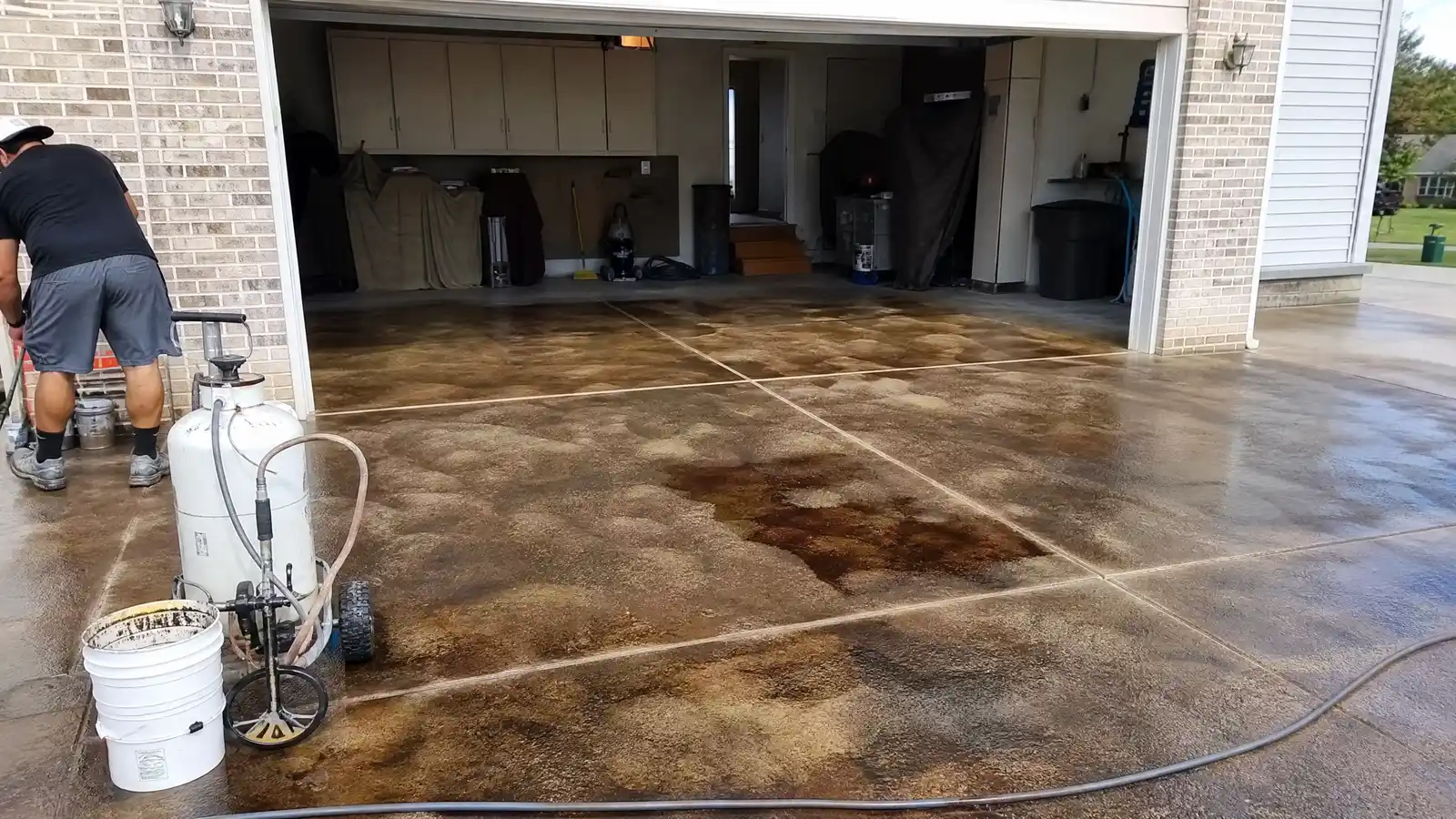
Stained Concrete Floors in Sumter, SC
Stained Concrete Floors in Sumter County, SC: rich color, easy cleaning and a floor that hides wear. Free on-site estimate and written price. Call for a quote.
Most people don’t think about their concrete until it starts to bother them. Maybe it’s oil spots in the garage, a patio that has gone blotchy gray, or a shop floor that makes a good showroom look tired. Sumter Epoxy Floors is a floor coating specialist based in Sumter County, SC, and concrete staining is one of the more natural-looking ways to fix that. Stained concrete floors keep the slab you already have and add depth, color and a finished look, without a thick film that can peel. It suits garages, patios, pool decks, shops and showrooms from Sumter to Dalzell, Pinewood and Mayesville.

Call (839) 600-9293 to talk it through, or read on for how it works.
What Prep Is Included
A stain is only as good as the slab underneath it. Prep on a typical job covers:
- Deep cleaning and degreasing to lift oil, dirt and residue
- Removing old paint, sealer, adhesive or coatings that would block the stain
- Grinding or profiling the surface, guided by ICRI Guideline 310.2R (concrete surface preparation)
- Repairing cracks, chips and rough patches
- Checking the slab for moisture
- A small test patch so you can approve the color before the whole floor is done
How Concrete Staining Actually Works
Staining colors the concrete itself instead of sitting on top of it like paint. The stain soaks into the surface and changes the slab’s color from within, so the result looks more like natural stone than a painted floor. A clear sealer then protects it.
Because every slab has its own mix, age and history, no two floors come out identical. Trowel marks, small variations and even old patches show up as part of the character. If you want a uniform, mirror-flat color, a pigmented coating may suit you better, and we’ll tell you so during the visit.
Who Gets the Most Out of It
Concrete staining tends to suit:
- Garage owners tired of a stained gray slab who want it to look finished
- Patio and pool deck owners who want warmer color and a sealed surface that cleans up easily
- Small business owners with a shop, office or showroom floor that needs a polished look on a practical budget
- Families in the Shaw AFB community and across Sumter County who want a floor that looks good with little upkeep
We serve properties along US 15, US 76/378 and SC 441, and the towns around them. A local visit means no long drive for your estimate or for any follow-up.
Acid vs. Water-Based Stain: Choosing the Right One
Acid stain contains mild acid and metallic salts that react with minerals in the concrete. The reaction creates rich, cloudy, variegated tones, mostly earthy browns, tans, rusts and soft blue-greens. The color is part of the slab, which is why it has a marbled look. Acid stain concrete works best on bare, clean, relatively unmarked surfaces, and it’s a good fit for homeowners who like a natural, one-of-a-kind appearance.
Water-based stain is a pigment-and-dye product that doesn’t rely on a chemical reaction. It offers a much wider color range, including bold shades, grays and blacks, and the results are more predictable from one area to the next. It’s often the better choice for businesses that want a particular brand color, or for slabs that won’t react well to acid.
Neither type is a magic cover-up. Both show cracks, patches and old marks to some degree. The test patch is how you decide. We put each option on your actual floor so you can see how it behaves before you commit.
Sealers: What Protects the Color
Stain gives the color, and the sealer gives the protection. Without it, a stained floor can pick up dirt and moisture, and the color can wear unevenly under foot and tire traffic.
Sealers come in a few main types:
- Acrylic sealers are common and easy to refresh, with a natural to glossy finish that suits patios and interior floors.
- Urethane and polyaspartic-type sealers form a tougher film, which matters in a garage where hot tires, oil and road chemicals take a toll.
- Penetrating sealers soak in rather than forming a surface layer, leaving a more natural, matte look.
Installers describe polyaspartic coatings as UV stable and as lasting 15 to 25 years with care, but those are manufacturer and installer claims, not independent test results (Concrete Network, accessed Oct 2026). Treat any lifespan as a hope, not a promise.
Hot tire pickup comes down to the sealer, not the stain, so for garages we match the product to how you use the space. We also recommend a slip-resistant additive on any surface that gets wet.
Indoor and Outdoor Use
Indoors, stained concrete is a practical, good-looking option for garages, workshops, basements, offices and showrooms. Sweeping and an occasional damp mop is usually enough, and there are no seams for dirt to hide in.
Outdoors, patios, walkways and pool decks take sun, rain and foot traffic, so sealer choice matters more. Sumter’s humid subtropical climate has average daily highs of 87.3°F in June, 90.2°F in July and 88.5°F in August (Wikipedia, Sumter, South Carolina, accessed Oct 2026). Heat and humidity push moisture through slabs, which is why moisture checks come first. Outdoor sealers should be UV-resistant, and we add texture where bare feet and wet surfaces mix.
A wet, glossy floor is the biggest slip concern. For businesses, OSHA’s walking-working surfaces rule (29 CFR 1910.22) expects floors to be kept free of slip hazards, so a business floor should get a slip-resistant finish.
Step by Step: From First Visit to Finished Floor
- On-site estimate. We look at the slab, ask how you use the space, and measure. You get a written quote afterward.
- Moisture and condition check. We test the slab and look for old coatings, oil saturation and cracks.
- Surface prep. We clean, remove old finishes, grind to the right texture and repair damage.
- Test patch and stain application. You approve a small sample, then the stain goes on in layers to build the color you chose.
- Neutralizing or rinsing and drying. Acid stains are neutralized and cleaned. Water-based products are allowed to set fully.
- Sealing and finishing. We apply the sealer in coats, with slip-resistant additives where needed, and walk you through care.
Why Moisture Testing Matters Before Staining
Moisture is the cause of most failed floor finishes. If water vapor is pushing up through the slab, it can cloud or blister the sealer, even when the stain itself looks fine.
Two common tests are used. The ASTM F2170 in-situ relative humidity test places probes at about 40 percent of slab depth when the slab dries from one side, or 20 percent when it dries from both sides (Wikipedia, Epoxy moisture control system, accessed Oct 2026). The ASTM F1869 calcium chloride test measures moisture vapor emission from only the top quarter inch of the slab, so it can miss deeper moisture (Construction Canada, accessed Oct 2026).
Typical coatings call for slab relative humidity of 75 percent or lower, but the maker’s data sheet sets the real limit for each product (One Stop Epoxy, accessed Oct 2026). We check the product data before we apply anything.
What You’ll Gain
- A floor that looks custom. Color and depth you can’t get from plain gray concrete.
- Easier cleaning. A sealed surface wipes up spills, dust and tire marks.
- Resistance to oil and hot tires. This depends on the sealer, so we choose one for how you use the floor.
- Less to peel. Stain soaks into the concrete, so there’s no thick layer to lift.
- Good value from the slab you have. No tearing out or replacing concrete.
Investment Guide: What Affects the Price
Several things move the price: the size of the floor, how much prep the slab needs, acid versus water-based stain, the type of sealer, any decorative work like borders or scoring, and whether the job is indoors or outdoors.
The published price guides we can cite are mostly for epoxy, so we won’t pass them off as stain prices. For comparison, epoxy flooring typically costs $2 to $12 per square foot installed (Angi, updated Aug 3, 2026). Prep costs are more transferable. Basic cleaning and etching adds about $1 to $2 per square foot, diamond grinding for damaged concrete about $2 to $4, and crack repair and patching about $3 to $5 (Intermountain Coatings, July 2025). A slab in good shape costs less to prepare than one with old coatings and cracks.
At the estimate visit we check the slab, talk about colors and sealers, and measure. The written quote itemizes the prep, products and timeline. It’s also reasonable to ask any contractor, including us, about licensing and bonding. Under South Carolina regulation 106-2, a licensed residential specialty contractor must hold a surety bond of at least $10,000 when a project costs more than $5,000 (South Carolina Code of Regulations ch. 106, current through Sept 2024).
Ready to See What Your Floor Could Look Like?
We’ll visit your garage, patio, pool deck or shop, check the slab, show you color and sealer options, and give you a written quote. Call (839) 600-9293 or Get a Free Estimate today.
How It Works
From first call to a floor you can drive on
Free on-site estimate
We look at the floor, check for cracks, stains and old coatings, and talk through color and finish.
Written quote
You get one clear quote listing the prep, the coating system and the days the work takes.
Grind and repair
We diamond-grind the concrete, fill cracks and joints, and clean the surface before any coating goes on.
Coat and finish
We apply the coating system in stages and finish with the color and texture you chose.
Frequently Asked Questions
The final price depends on floor size, slab condition, stain type and sealer, so it's quoted after a visit. As a reference, epoxy flooring typically runs $2 to $12 per square foot installed (Angi, updated Aug 3, 2026), and stain prep costs are similar. Your free written quote itemizes each part of the work.
Stain soaks into the concrete, so it doesn't peel the way a thick film can. The sealer on top is the layer that can wear or lift, usually from moisture, poor prep or traffic. That's why we test for moisture, prep the surface properly and choose a sealer that suits garage or outdoor use.
Yes, it's worth doing. Moisture pushing through a slab can cloud or blister the sealer. Standards like ASTM F2170 measure relative humidity inside the slab, and typical coatings call for 75 percent or lower, though the product data sheet sets the real limit (One Stop Epoxy, accessed Oct 2026). We check before we begin.
They can be, especially with a glossy sealer. A slip-resistant additive in the final coat adds grip, and it's the right choice for pool decks, patios, entryways and any business floor. OSHA's walking-working surfaces rule (29 CFR 1910.22) expects workplace floors to be kept free of slip hazards, so ask about texture during the estimate.
Stain needs bare, clean concrete, so old paint, sealer and glue have to be removed first. Cracks can be repaired, but patches and hairline cracks usually remain visible in the finished color. Many people like that look, and we show you a test patch first so you know what to expect.
Ready for a floor that lasts?
Tell us about your garage, patio or shop floor. We reply with a written estimate and explain exactly how the concrete will be prepared.