
Epoxy Floor Repair in Sumter, SC
Epoxy Floor Repair & Removal in Sumter County, SC: fix peeling coatings and cracks for a cleaner, longer-lasting garage or patio floor. Call for a quote.
Tap to call: (839) 600-9293

A clean, even garage floor is something to be proud of. A coating that lifts at the door or shows tire marks is not. If you’ve already paid for one floor, the last thing you want is to pay for a second that fails. Sumter Epoxy Floors handles epoxy floor repair and removal for garages, patios, pool decks, shops and showrooms across Sumter County, including Shaw AFB neighborhoods, Dalzell, Pinewood, Mayesville and Manning.
Prep included on every job:
- A moisture check of the slab
- Grinding to a clean, profiled surface
- Crack and chip repair before any new coating
- Full dust removal
Understanding the Process
Epoxy is a hard plastic-like coating bonded to concrete. When it fails, the coating usually isn’t the problem. The bond is. Repair means finding out why the bond broke, then fixing the slab and the coating together.
Sometimes a small failed area can be ground out and patched. Other times the old coating has to come off completely, because new epoxy over a loose layer will fail the same way. Concrete crack repair often comes first, since a moving crack will telegraph through fresh coating.
Where Peeling and Bubbling Come From
Peeling and bubbling usually come from moisture, poor prep or hot tires. Moisture vapor rising through the slab pushes up under the coating and forms blisters. Thin spots or a dirty, smooth surface let the epoxy grab only loosely, so it lifts in sheets.
This is common in Sumter because summers are humid. Average daily highs reach 87.3°F in June, 90.2°F in July and 88.5°F in August (Wikipedia, Sumter, South Carolina, accessed Oct 2026). Warm, damp air and wet ground make slabs hold water.
Repair starts by locating the damaged area and checking why it failed. Loose material gets ground away back to sound concrete. If moisture is the cause, the slab needs testing before anything new goes on. Polyaspartic coatings shouldn’t go over a slab with a high moisture vapor emission rate, because moisture can make the coating bubble up and lift (Concrete Network, accessed Oct 2026).
This section suits homeowners with a floor that’s peeling at the garage door, bubbling in spots or flaking off under the car. The payoff is a repair that addresses the cause, not one that hides the symptom for a season.
Taking Off an Old Coating
When a coating is peeling widely, yellowed, or layered over earlier paint, removal is the safer route. Patching over a weak layer just gives the new coating a weak foundation.
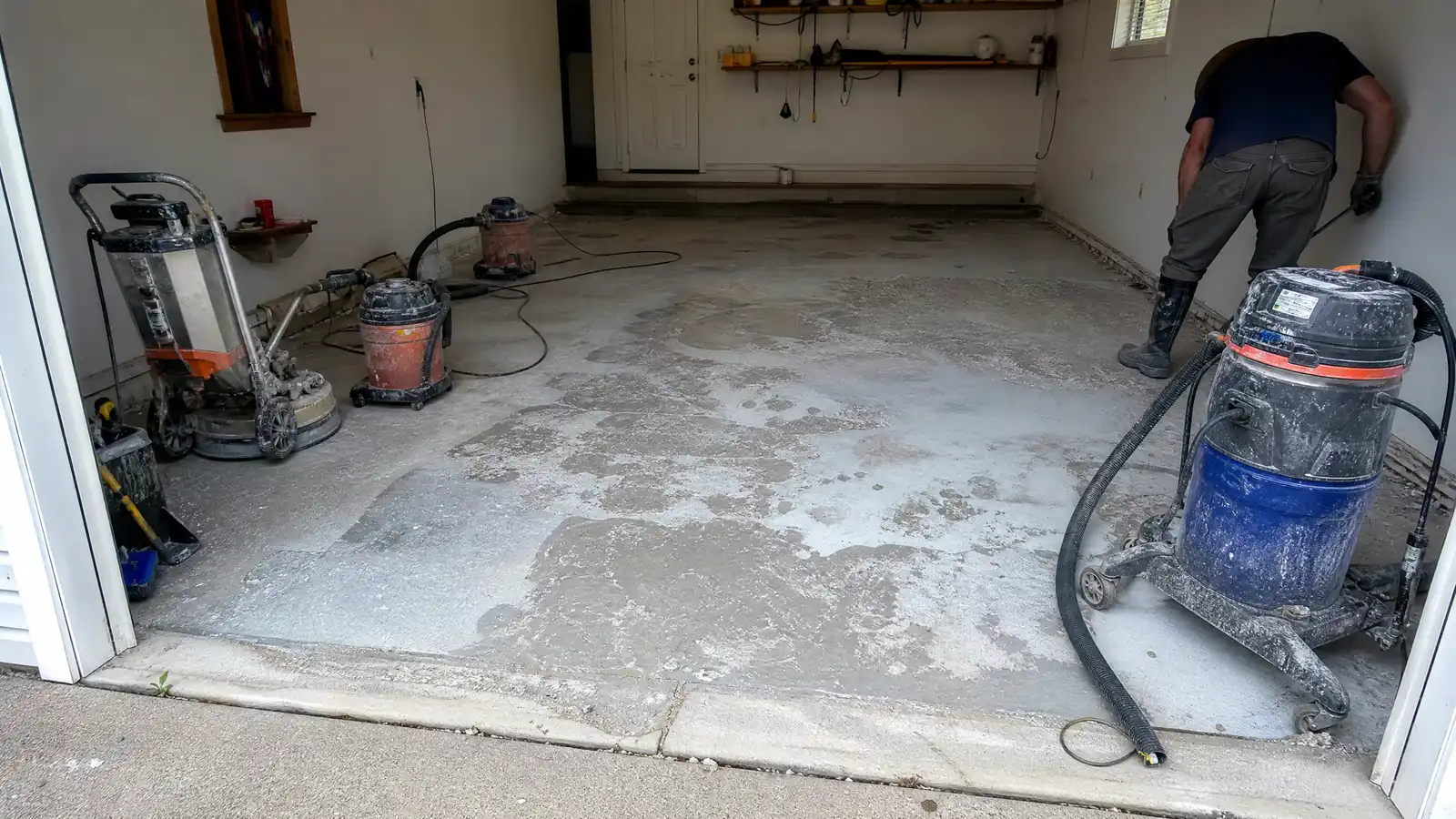
Removal is done with diamond grinders and, where needed, scrapers, which take off the coating and a thin layer of surface concrete. The goal is a clean, even surface with the texture a new coating needs to grip, following ICRI Guideline 310.2R (concrete surface preparation for coatings). Dust is collected as we work, so it doesn’t spread through your garage or shop.
Removal fits floors where earlier DIY kits or paint failed, coatings that have turned chalky or discolored, and buildings where the owner wants a fresh start. It also suits small business owners who are tired of patching a showroom or shop floor.
The benefit is a true reset. You get exposed, sound concrete, a clear view of cracks and moisture problems, and the choice of recoating, sealing or leaving the concrete polished and bare.
Crack and Spall Repair
A crack is a split in the slab. A spall is a chip or flake where the surface has broken away, often at joints, door edges or where road salt, oil or impact has worn the concrete down. Left alone, both let water in and show through any coating placed over them.
Repair depends on the damage. Hairline cracks may be routed and filled with a flexible or rigid repair material. Wider cracks may need more work. Spalls are cleaned out to solid concrete and rebuilt with a patching compound, then ground flush so the surface is level.
This work is for anyone with a cracked garage slab, chipped control joints, or a patio or pool deck with flaking surface concrete. Pool decks matter especially, as damaged areas can be uneven underfoot, and OSHA 29 CFR 1910.22 (walking-working surfaces) is a useful reminder that walkways should be kept in a safe condition for workplaces.
The benefit is a smoother, safer floor and a coating that doesn’t show every crack. If a crack keeps moving or the slab is settling, we’ll tell you plainly, since a coating can’t solve a structural problem.
Moisture Testing Before Any New Coating
Most coating failures trace back to moisture and prep, so testing matters. The ASTM F2170 in-situ relative humidity test places probes at about 40 percent of slab depth for slabs that dry from one side, or 20 percent when they dry from both sides (Wikipedia, Epoxy moisture control system, accessed Oct 2026). Another common method, the ASTM F1869 calcium chloride test, measures only the top quarter inch of the slab, so it can miss deeper moisture (Construction Canada, accessed Oct 2026).
Typical epoxy coatings call for slab relative humidity of 75 percent or lower, but the coating maker’s data sheet sets the real limit for each product (One Stop Epoxy, accessed Oct 2026). We’ll explain your result in plain language and what it means for your product choice.
Step by Step
- Look and listen. We walk the floor, tap for hollow spots, and note stains, cracks and edges.
- Test moisture. We check the slab before choosing a coating.
- Remove what’s failing. Loose or damaged coating is ground off to sound concrete.
- Repair the concrete. Cracks are filled, spalls rebuilt and the surface leveled.
- Clean and profile. The slab is vacuumed and given the texture the coating needs.
- Recoat or finish. A new coating goes on, or the cleaned concrete is sealed if that’s what you want.
What You’ll Gain
- A floor that lasts. Good prep gives the coating something solid to bond to.
- Easier cleaning. A sealed surface wipes down instead of soaking up oil and grime.
- Resistance to hot tires. Proper prep and the right product reduce the lifting that follows a summer drive.
- Better footing. Texture can be added for patios, pool decks and wet areas.
- A better look. Cracks, stains and patchy paint disappear.
Investment Guide
Repair and removal are priced after we see the floor, because every slab is different. The main factors are square footage, how much coating needs to come off, the number and size of cracks, and which new coating you choose.
For perspective, Intermountain Coatings (July 2025) lists basic cleaning and etching at about $1 to $2 per sq ft, diamond grinding for damaged concrete at about $2 to $4 per sq ft, and crack repair and patching at about $3 to $5 per sq ft. Those figures are for prep work added to a new coating. Epoxy flooring typically costs $2 to $12 per sq ft installed, according to Angi (updated Aug 3, 2026). Angi also puts a one-car garage (about 250 sq ft) at $750 to $3,000 and a two-car garage (about 500 sq ft) at $1,500 to $6,000. A Lexington, SC installer publishes garage floor bands of $1,500 to $2,500 (base), $2,500 to $4,000 (average) and $4,000 to $8,000 (high-end) (Midlands Pro Painters). Treat all of these as ballparks. I don’t have a verified published price for removal alone.
The estimate visit is free. We look at the floor, discuss moisture, and give you a written quote that lists the prep and the coating. Timeline and cure time are confirmed there, because they depend on the product and the condition of the slab.
Get Your Floor Looked At
If your floor is peeling, bubbling, cracked or just worn out, we’re local to Sumter County and can come by along US 15, US 76/378 or SC 441. We’ll check the slab, explain the prep, and give you a written quote with no pressure. Call (839) 600-9293 or Get a Free Estimate today.
How It Works
From first call to a floor you can drive on
Free on-site estimate
We look at the floor, check for cracks, stains and old coatings, and talk through color and finish.
Written quote
You get one clear quote listing the prep, the coating system and the days the work takes.
Grind and repair
We diamond-grind the concrete, fill cracks and joints, and clean the surface before any coating goes on.
Coat and finish
We apply the coating system in stages and finish with the color and texture you chose.
Related Guides
Helpful articles to learn more about this service.
Frequently Asked Questions
It depends on the condition of the slab and the coating you choose, so we price after a visit. As a guide, Intermountain Coatings (July 2025) puts grinding for damaged concrete at about $2 to $4 per sq ft and crack repair at about $3 to $5 per sq ft. You get a written quote after the free estimate.
Hot tire pickup is when warm tires lift a coating that didn't bond well. It's usually a prep or product problem, not just heat. Sumter summers reach 90.2°F average highs in July (Wikipedia, accessed Oct 2026), so a good surface profile and a suitable product matter. If your floor already lifts under the tires, it needs to be ground back and redone.
Yes, in most cases. Moisture is a common reason coatings bubble and peel, and a test shows whether the slab is dry enough. Typical epoxy calls for slab relative humidity of 75 percent or lower, but the maker's data sheet sets the real limit (One Stop Epoxy, accessed Oct 2026). We'll explain which test is used and what the result means for your floor.
Usually not directly. Paint or a failing coating should be removed so the new layer bonds to concrete, not to something loose. Cracks should be repaired first, or they'll show through. If the old coating is sound and well bonded, a lighter prep may work. We'll check this at the estimate and tell you what we find.
It depends on the product, the temperature and humidity, and the thickness applied. Cure times vary, so we follow the manufacturer's data sheet and put the timing in your written quote. Foot traffic generally comes before vehicles. We'll tell you exactly when it's safe to walk on the floor and when to park inside again.
Ready for a floor that lasts?
Tell us about your garage, patio or shop floor. We reply with a written estimate and explain exactly how the concrete will be prepared.