
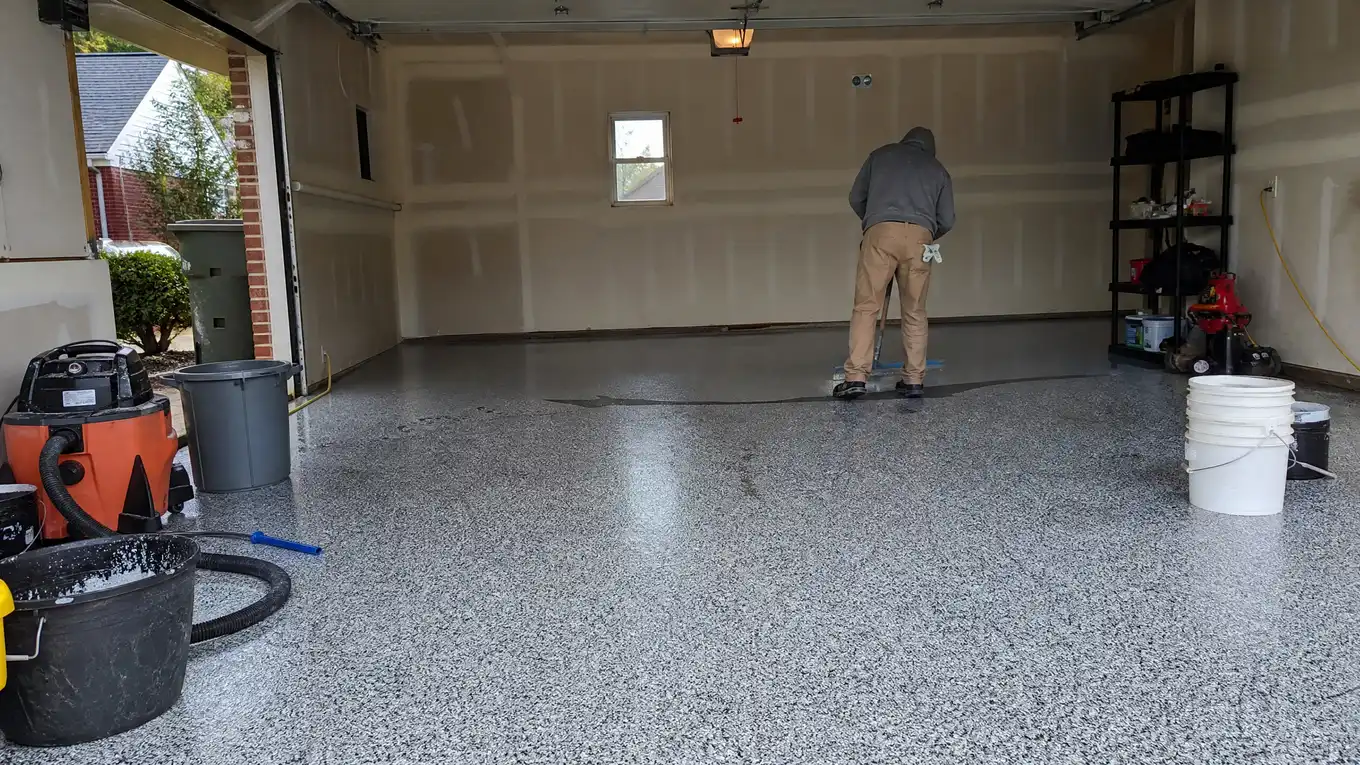
Warehouse Floor Coating in Sumter, SC
Shop, Warehouse & Industrial Floor Coatings in Sumter County, SC: tough, easy-to-clean floors that handle forklifts, oil and chemicals. Call for a quote.
A bare concrete floor in a shop or warehouse takes a beating from forklifts, dripping oil, dragged pallets and constant foot traffic. Once it starts dusting, staining or flaking, it gets harder to clean and harder to keep safe. Sumter Epoxy Floors is a floor coating specialist based in Sumter County, so estimates and follow-up visits stay close to home. A properly prepared warehouse floor coating turns raw concrete into a sealed, easy-to-clean surface that holds up to daily work. This page covers shops, warehouses, garages and workspaces, and it explains the prep that decides whether a coating lasts or peels. You can also call (839) 600-9293 to talk it through.

Understanding What Goes Onto Your Slab
An epoxy shop floor is a liquid resin that bonds to the concrete and hardens into a tough, continuous layer. Industrial jobs usually build that layer in stages: a primer that grips the slab, one or more body coats for thickness, and often a clear topcoat for wear and chemical resistance. Some systems add fine aggregate for grip.
Which product fits depends on how the space is used. Water-based epoxy suits lighter work. Solid-content epoxy builds a thicker film for heavier traffic. Polyaspartic topcoats cure quickly and handle sunlight well. Installers describe them as lasting 15 to 25 years with care, though that is a manufacturer and installer claim, not an independent test result (Concrete Network, accessed Oct 2026). We help you match the system to your floor in the written quote.
Who Needs an Industrial Floor Coating?
Anyone whose concrete works harder than a typical garage slab. That includes:
- Small manufacturers and fabrication shops around Sumter
- Warehouses and distribution space off US 15 and US 76/378
- Auto repair bays and detail shops along SC 441
- Showrooms and retail back rooms in Dalzell, Pinewood and Mayesville
- Farm equipment shops near Manning, Camden and Bishopville
- Shaw AFB community members with a home workshop or a side business in a large garage
Forklifts and Heavy Traffic
A coating for heavy traffic needs thickness, a well-prepared slab and the right hardness. Forklift tires concentrate weight on small contact patches, and hard turns scrape and shear the surface. A thin, rolled-on coat can tear in the turning lanes within months, which is why these floors need a thicker build and more careful prep.
Heavy-duty systems use high-solids epoxy or a similar resin, often with a wear-resistant topcoat. Joints and cracks get filled first, because forklift wheels will find every edge. Where loading docks or aisles see the most use, we can discuss a heavier build in those zones and a lighter one elsewhere.
This is for warehouse operators, shop owners running pallet jacks and lift trucks, and anyone who rolls loaded carts across the floor. The benefit to you is a floor that stays smooth under load, doesn’t generate concrete dust that coats inventory, and sweeps and mops clean instead of grinding grit into the slab. It also means fewer repairs and less downtime for resurfacing. Every product has its own load and cure limits in the maker’s data sheet, and we’ll put those details in writing so nobody guesses.
Chemical Resistance
Resistance depends on the resin and on what spills. No coating is immune to everything. Bare concrete soaks up oil, brake fluid, coolant, fertilizer and cleaning solutions. Once absorbed, those fluids stain permanently and can weaken the surface. A sealed coating keeps them on top, where you can wipe them up.
Epoxy handles most oils, fuels and many cleaners well. Some harsh acids and solvents will mark or soften certain systems, so we ask what you use before recommending a product. A chemical-resistant topcoat, or a different resin for a battery-charging or wash-down area, may be worth the extra step.
This section is for mechanics, fabricators, farm shops, food-adjacent storage and anyone who keeps drums, batteries or solvents on site. The benefit is a floor that doesn’t hold stains, doesn’t smell of old oil and doesn’t need harsh scrubbing. Cleanup takes a rag or a mop instead of a grinder. Tell us what actually hits your floor, and we’ll check it against the product data sheet before you commit.
Line Striping and Safety Zones
Painted lines work best when they are part of the coating system, not an afterthought. Striping marks forklift aisles, walkways, loading areas, machine clearances and storage bays. Applied over a cured, properly prepared coating with compatible paint or resin, the lines last far longer than paint on bare concrete.
Safe floors also depend on traction. OSHA 29 CFR 1910.22 covers walking-working surfaces and expects them to be kept in a condition that doesn’t create slip or trip hazards. We can add fine anti-slip aggregate to a coating so wet or oily areas keep their grip. Smooth finishes look sharp, but a textured one is the better choice near doors, wash areas and ramps.
This work suits warehouse managers, shop owners with employees or visitors, and small businesses that want an orderly floor. The benefit is a workspace that is clearer to navigate, easier to keep organized and better looking for customers. Layout drawings are welcome. If you don’t have one, we can walk the space with you and mark out zones during the estimate.
From First Call to Finished Job
- Free on-site estimate. We measure, look at the slab’s condition, ask how the floor is used and talk through your options. You get a written quote afterward.
- Moisture testing. Moisture rising through concrete is a common cause of bubbling and peeling. The ASTM F2170 in-situ relative humidity test places probes at about 40 percent of slab depth when a slab dries from one side, or 20 percent when it dries from both (Wikipedia, Epoxy moisture control system, accessed Oct 2026). The ASTM F1869 calcium chloride test reads only the top quarter inch of the slab, so it can miss deeper moisture (Construction Canada, accessed Oct 2026).
- Surface preparation. Diamond grinding opens the concrete and removes old coatings, laitance and contamination. We follow the surface-profile principles in ICRI Guideline 310.2R. Oil gets treated, and vacuums remove dust.
- Repairs. Cracks, spalls and joints are filled and leveled before coating starts.
- Coating application. Primer, body coats, any grip aggregate and topcoat go on in order, with the maker’s recoat windows respected.
- Cure and walkthrough. We review the finished floor with you and explain when foot, vehicle and forklift traffic can resume, based on the product data sheet.
What You Gain
- Durability: a hard surface that stands up to wheels, dropped tools and pallets
- Easy cleaning: sealed concrete wipes up instead of absorbing spills
- Less dust: no more fine powder on stock or equipment
- Brighter space: light-colored coatings reflect more light
- Safer footing: texture options for wet or oily areas
- A better impression: a clean floor reads well to clients walking in
Humid Summers and Concrete Moisture
Sumter has a humid subtropical climate, with average daily highs of 87.3°F in June, 90.2°F in July and 88.5°F in August (Wikipedia, Sumter, South Carolina, accessed Oct 2026). Humidity and heat both affect how concrete holds moisture and how coatings cure. Typical epoxy coatings call for slab relative humidity of 75 percent or lower, but the maker’s data sheet sets the real limit for each product (One Stop Epoxy, accessed Oct 2026). Polyaspartic coatings should not go on a slab with a high moisture vapor emission rate, because moisture can make them bubble and lift (Concrete Network, accessed Oct 2026). That’s why we test before we quote a system.
Investment Guide
Pricing depends on square footage, the condition of the slab, the product and the finish. Epoxy flooring typically costs $2 to $12 per square foot installed, including materials and labor (Angi, updated Aug 3, 2026). Another guide puts professional installation at $6 to $15 per square foot (Intermountain Coatings, July 2025), while ArmorGarage lists $7 to $9 (ArmorGarage, 2026). Product type moves the number: water-based runs about $3 to $7 per square foot, 100% solids epoxy $5 to $12 and metallic epoxy $8 to $15 (Intermountain Coatings, July 2025).
Prep can add cost. Basic cleaning and etching adds about $1 to $2 per square foot, diamond grinding of damaged concrete about $2 to $4, and crack repair and patching about $3 to $5 (Intermountain Coatings, July 2025). Large industrial floors are priced by the job, so these figures are only a guide.
Timeline depends on size, repairs and cure requirements. We’ll state it in the written quote after seeing the space. The estimate visit is free, and we look at the slab, check conditions and discuss use, color and finish.
Ready to Fix Your Floor?
If your concrete is dusty, stained, flaking or just wearing out, send us the details and we’ll look at it in person. We cover Sumter, Dalzell, Pinewood, Mayesville, Manning, Camden, Bishopville and the routes in between, including the Shaw AFB area. For shop, warehouse and industrial floor coatings, the first step is simple: Get a Free Estimate. You can also call (839) 600-9293 and we’ll answer your questions.
How It Works
From first call to a floor you can drive on
Free on-site estimate
We look at the floor, check for cracks, stains and old coatings, and talk through color and finish.
Written quote
You get one clear quote listing the prep, the coating system and the days the work takes.
Grind and repair
We diamond-grind the concrete, fill cracks and joints, and clean the surface before any coating goes on.
Coat and finish
We apply the coating system in stages and finish with the color and texture you chose.
Frequently Asked Questions
Expect roughly $2 to $12 per square foot installed for epoxy, depending on product and prep (Angi, updated Aug 3, 2026). Heavy-duty industrial systems, damaged slabs and repairs sit toward the higher end. Square footage, crack repair, grinding and topcoat choice all change the total. We give a written quote after a free on-site visit.
Yes. Moisture moving up through a slab is a common reason coatings bubble or peel. ASTM F2170 probes measure relative humidity inside the slab, while ASTM F1869 only reads the top quarter inch (Construction Canada, accessed Oct 2026). Typical epoxy calls for 75 percent or lower, but the product data sheet sets the limit (One Stop Epoxy, accessed Oct 2026).
Neither wins everywhere. Epoxy builds a thick, cost-effective film and handles most shop use. Polyaspartic cures fast and tolerates sunlight, and installers claim 15 to 25 years with care (Concrete Network, accessed Oct 2026). Moisture can ruin either, so testing comes first. We'll recommend one based on your traffic, budget and downtime.
A well-prepped, correctly cured system resists hot-tire pickup and forklift wear. Failures usually trace back to poor prep, moisture or driving on the floor too early. Heavy forklift lanes may need a thicker build or tougher topcoat. We'll explain your product's cure schedule before work begins.
It can be if the finish is smooth. We can mix fine anti-slip aggregate into the topcoat for added grip, which matters near doors, wash areas and ramps. OSHA 29 CFR 1910.22 expects walking-working surfaces to be kept in safe condition, so tell us where moisture or oil tends to collect.
Ready for a floor that lasts?
Tell us about your garage, patio or shop floor. We reply with a written estimate and explain exactly how the concrete will be prepared.