
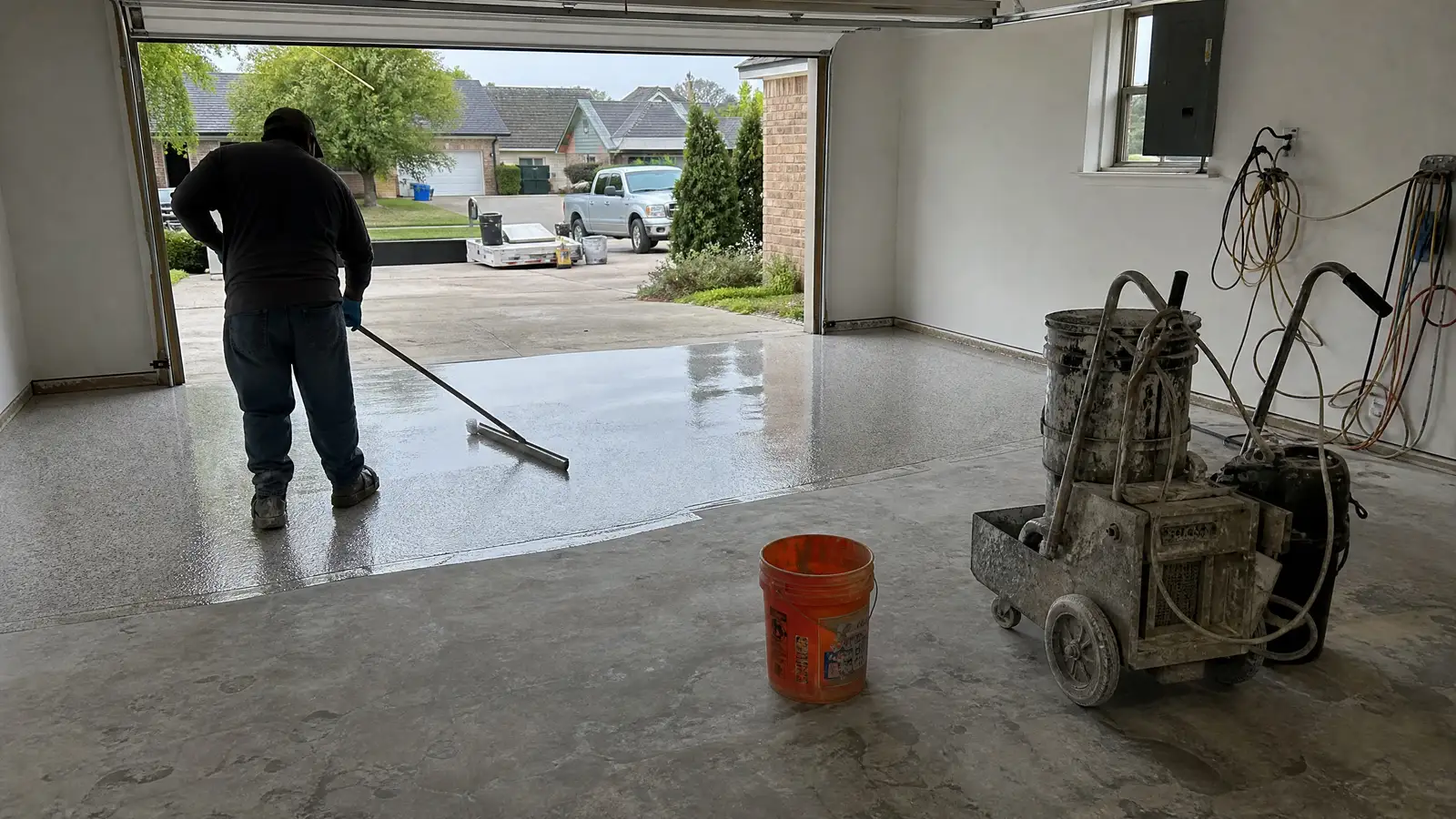
Commercial Epoxy Flooring in Sumter, SC
Commercial Epoxy Flooring in Sumter County, SC gives shops, showrooms and kitchens a durable, easy-clean floor, with moisture testing. Call for a quote.
A clean, even floor says something about your business before anyone speaks. A coating that peels, stains or turns slick says something too, and you end up paying for it twice. Sumter Epoxy Floors is a floor coating specialist based in Sumter County, SC. We install commercial epoxy flooring in shops, showrooms, restaurants and workspaces, from Sumter out to Dalzell, Mayesville, Manning and Bishopville. Epoxy is a two-part resin that bonds to concrete and cures into a hard, sealed surface. What decides whether it lasts is the prep underneath. Whether your building sits along US 15, US 76/378 or SC 441, we start with a free on-site estimate and a written quote, and we explain each prep step before any work begins.

How the Coating Actually Works
Epoxy isn’t paint. The resin and hardener are mixed on site and rolled over concrete that has been ground open, so the coating grips the slab instead of sitting on top of it. A typical system has a primer, one or more body coats, and a clear topcoat. Color flakes, quartz or a fine grit can be added for looks and traction.
The result is a sealed, wipe-clean surface that handles forklift traffic, oil, cleaning chemicals and hot tires far better than bare concrete. Different products suit different jobs, which is why the estimate visit matters.
Businesses That Get the Most From It
Commercial floor coating suits auto and repair shops, warehouses, workshops, salons, offices, breweries and any space where bare concrete stains or sheds dust. We also work with businesses serving the Shaw AFB community, and with owners who run a shop from a home property. If your slab is stained, dusty, cracked or peeling from an earlier coating, it’s a good candidate for a look.
Showrooms and Retail
A showroom floor works as part of your display. Customers look down as they walk, and a glossy, even surface makes vehicles, furniture and product lines look better. Epoxy gives you that finish in solid colors, flake blends or metallic effects, and it resists scuffs from carts, dollies and shoes.
This section is for car dealers, boutiques, furniture stores, gyms and offices that want a polished look without the upkeep of waxed tile or sealed concrete. Day to day, a dust mop and a damp mop handle most cleaning, and spills wipe up instead of soaking in.
Retail floors also need grip. A glossy coating can be slick when wet, so we talk through added texture, especially near entrances where rain gets tracked in. OSHA 29 CFR 1910.22 covers walking-working surfaces in workplaces, so traction is part of the design.
For you, the benefit is a floor that looks sharp for customers and takes less time and money to maintain. At the estimate, we look at your lighting, foot traffic and layout, then suggest a color and finish that fits your brand.
Restaurants and Kitchens
Kitchen floors take a beating from grease, hot water, dropped pans, harsh cleaners and constant washdowns. Epoxy forms a sealed surface with no grout lines for grime to settle into, and it can be coved up the wall so water and debris don’t collect at the edges.
This section is for restaurants, cafes, bakeries, catering kitchens and food prep rooms. Texture matters most here. A greasy, wet floor needs real traction, so we build in grit that grips boots without making the floor impossible to clean. Heat matters too. Let us know about steam, hot water dumps and floor drains, because heavier-duty systems exist for those conditions.
Health inspectors may have their own requirements for floor finishes, so check them before choosing a system and share them with us at the estimate.
The owner benefit is a floor that’s easier to keep sanitary, safer underfoot and less likely to crack or crumble than worn tile. It also saves cleaning time for staff.
Downtime Planning
Closing your doors costs money, so we plan around that early. The right schedule depends on the size of the space, the condition of the slab, the system you choose and how much repair the concrete needs. Cure times vary by product, and the manufacturer’s data sheet sets the real numbers.
This section is for owners who can’t afford a long shutdown, such as shops with bays that can be done in sections or restaurants that need to know exactly when the kitchen is usable again.
At the estimate, we walk the space with you and talk about which areas could be coated first and what needs to be moved. Your written quote spells out the scope and the work, so you can plan staff and deliveries instead of guessing.
Rushing a cure is a common reason coatings fail, so the schedule includes real cure time before foot traffic, wheeled traffic or heavy equipment goes back on the floor. We’ll tell you when each stage is done and when the floor is ready for use.
Step by Step: From First Visit to Finished Floor
- Free on-site estimate. We measure the space, look at the slab, ask how the floor is used, and give you a written quote.
- Moisture testing. Sumter summers are humid, with average highs of 87.3°F in June, 90.2°F in July and 88.5°F in August (Wikipedia, Sumter, South Carolina). Moisture can travel up through a slab and push a coating off. The ASTM F2170 in-situ relative humidity test places probes at about 40 percent of slab depth for slabs that dry from one side (Wikipedia, Epoxy moisture control system). The ASTM F1869 calcium chloride test only reads the top quarter inch, so it can miss deeper moisture (Construction Canada).
- Grinding and repair. We grind the concrete to the surface profile described in ICRI Guideline 310.2R, then fill cracks and chips. This is the step that decides whether the coating stays put.
- Primer and body coat. The primer soaks into the prepared concrete, and the body coat builds thickness and color.
- Topcoat, texture and cure. A clear topcoat protects against wear, with grit added where you need traction. We give you cure times before the floor goes back into service.
What You’ll Gain
- Durability: Epoxy handles foot traffic, rolling loads and dropped tools better than bare concrete.
- Easy cleaning: The sealed surface doesn’t hold dust, oil or spills.
- Chemical and hot tire resistance: A properly prepped, properly cured system stands up to oil, cleaners and warm tires.
- Traction: Added texture helps reduce slips in wet or greasy areas.
- Appearance: Solid colors, flakes and metallic finishes make a space look finished and professional.
What It Costs and What Affects the Price
Pricing varies by building, so treat these numbers as national guides, not quotes. Epoxy typically runs $2 to $12 per square foot installed, with materials and labor included (Angi, updated Aug 3, 2026). Professionally installed epoxy totals about $6 to $15 per square foot (Intermountain Coatings, July 2025), and one source puts professional installs at $7 to $9 per square foot (ArmorGarage, 2026).
By system, water-based epoxy runs about $3 to $7 per square foot, solvent-based $4 to $9, 100% solids $5 to $12 and metallic $8 to $15 (Intermountain Coatings, July 2025). Prep adds to the total. Basic cleaning and etching adds about $1 to $2 per square foot, diamond grinding for damaged concrete about $2 to $4, and crack repair about $3 to $5 (Intermountain Coatings, July 2025).
Beyond those, price depends on square footage, slab condition, moisture problems, texture, cove base and how easily we can get in. At the estimate, we measure, inspect the slab, discuss how you use the floor and put the figures in a written quote.
Ready for a Floor That Holds Up?
If you’re comparing quotes, we’ll come to your Sumter County site, check the slab, explain the prep and put everything in writing. Call (839) 600-9293 or Get a Free Estimate today.
How It Works
From first call to a floor you can drive on
Free on-site estimate
We look at the floor, check for cracks, stains and old coatings, and talk through color and finish.
Written quote
You get one clear quote listing the prep, the coating system and the days the work takes.
Grind and repair
We diamond-grind the concrete, fill cracks and joints, and clean the surface before any coating goes on.
Coat and finish
We apply the coating system in stages and finish with the color and texture you chose.
Related Guides
Helpful articles to learn more about this service.
Frequently Asked Questions
Expect roughly $2 to $12 per square foot installed, materials and labor included (Angi, updated Aug 3, 2026). Professional installs commonly total $6 to $15 per square foot (Intermountain Coatings, July 2025). Slab condition, the type of system and any moisture work move you within that range, so a written quote after a site visit is the only reliable number.
Yes. Moisture rising through the slab is a leading cause of bubbling and peeling. Typical epoxy coatings call for slab relative humidity of 75 percent or lower, but the coating maker's data sheet sets the real limit for each product (One Stop Epoxy). Testing before the job tells us whether the slab is ready or needs a moisture-control step first.
Both can work, and the slab often decides. Installers describe polyaspartic as UV stable and long-lasting, at 15 to 25 years with care, though those are manufacturer and installer claims, not independent tests (Concrete Network). Polyaspartic shouldn't go on a slab with a high moisture vapor emission rate, because it can bubble and lift (Concrete Network). Moisture results help us choose.
A smooth, glossy epoxy can be slick when wet, but it doesn't have to be. We add grit or texture to the topcoat in areas like entrances, kitchens and wash bays. OSHA 29 CFR 1910.22 covers workplace walking-working surfaces, so traction is worth settling before the coating goes down. Tell us where spills or rain are likely.
Usually not directly. Old paint or a failing coating has to be ground off so the new epoxy bonds to concrete rather than a weak layer. Cracks and chips get repaired first, since crack repair and patching adds about $3 to $5 per square foot (Intermountain Coatings, July 2025). Wide or moving cracks may need a different repair, which we'll explain at the estimate.
Ready for a floor that lasts?
Tell us about your garage, patio or shop floor. We reply with a written estimate and explain exactly how the concrete will be prepared.